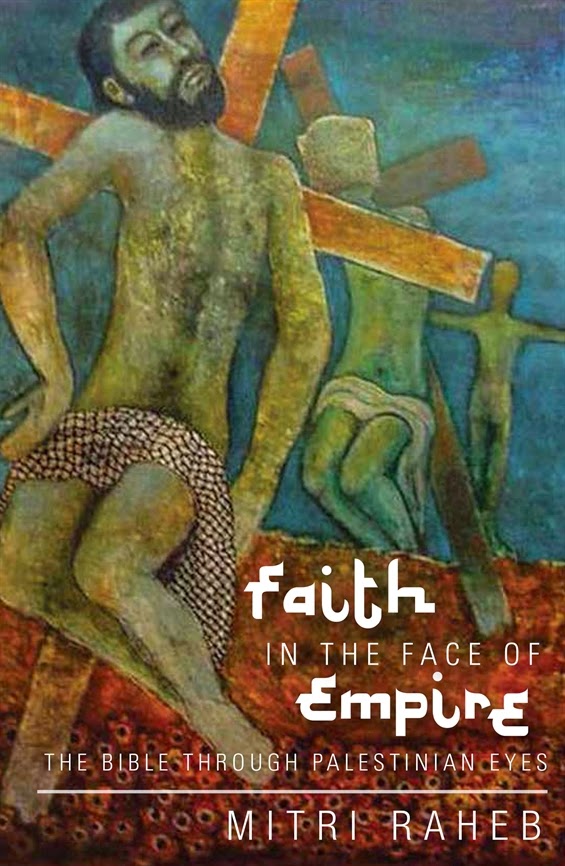
The humanity of Jesus is not to be considered as a philosophical puzzle and carefully dovetailed with his preexistent divinity, but observed in its ordinary expressions in everyday life. Taking the humanity of Jesus seriously means that we notice his ethnicity, his religion, his economic status, and his political situation. If such categories seem odd for a discussion of Jesus it may well be an indication of just how little significance we have attributed to the humanity of Jesus.
A Palestinian Jesus
This first attribute of the historical Jesus may come as a surprise since ‘Palestinian’ has largely become a pejorative term in recent Western discourse. I am, of course, using the term as a geographical descriptor, rather than an ethnic or a political identity. Jesus was indigenous to the land of Palestine,[1] and he lived there at a time when it was—once again—under the control of a foreign imperial power exercising its authority through local puppet rulers.
One of the continuing tragedies of our time is the theft not only of the Palestinians’ land, but also their culture and history, so essential for their identity.[2] In the struggle for possession of their historical lands, the Palestinians have been represented as violent extremists, while the systematic violence directed towards them is overlooked or excused.[3]
If we put aside the caricature of Palestinians as anti-Semitic terrorists, what might it mean to consider Jesus as a Palestinian? The first and most significant element may simply be to dislodge traditional assumptions and expectations. A ‘Palestinian Jesus’ is as incongruous to many people as the term ‘Palestinian Jew’ even though the latter term was not unusual prior to 1948.
Yet, as Naim Ateek reminds us,[4] Jesus the Palestinian was an oppressed and marginalized person, as well as a liberation theologian. There are few peoples in the world more marginalized than the Palestinians, and Jesus shares their experience both as someone indigenous to Palestine and as someone who suffered undeserved violence from the imperial powers of his own time.
Jesus the Palestinian is God doing theology from the bottom up, rather than from the top down. The imperial churches of Rome, Geneva, and Canterbury—to name just three historical expressions of Christianity—have always preferred to do their theology the other way around. The Palestinian Jesus challenges his followers to lay aside our inherited privileges and stand among the poor and the dispossessed, where God is more often to be found than in the cathedrals and chapels of Christendom.
A Jewish Jesus
Alongside the Palestinian Jesus we place the Jewish Jesus. They are the same person. Why does this surprise us? What assumptions and stereotypes continue to control our thinking if we find this a strange combination? Jesus was a Palestinian Jew. (Paul, on the other hand, was a Diaspora Jew.)
For almost two thousand years the Jews were the despised ‘other’. In the Christian West, the devotees of Jesus the Jew hated his people and subjected them to shameful discrimination and violence. The horror of the Holocaust in Nazi Germany was not so much an aberration as the most extreme example of Christian anti-Semitism. Jesus would have been sent to a Nazi death camp had he been found in occupied Europe during the 1940s. Jesus was sent to the death camps. He was crucified again and again in the gas chambers and the ovens.
The Jewish Jesus confronts our suspicion of the Jew, and of anyone who is different from us. The Jewish Jesus compels us to see that God’s mercy is more ancient than Christianity. The Jewish Jesus invites us to imagine a way of being religious that is not about orthodoxy, but service; forming communities that—in their best moments—live the covenant and provide a light to the nations.
Jesus was a particular person, with a distinctive culture and a religion that refused to be domesticated by the dominant cultural and political powers of his day. As a Jew, as someone who shared the Jewish historical experience of oppression and loathing, Jesus challenges his own followers to embrace their own religious tradition without rejecting, fearing, or persecuting those of other faiths.
Jesus the Jew resisted power and privilege, and that cost him his life. On Good Friday it seemed that privilege and power had won the contest, but three hundred years later the emperor of Rome was a devotee of Jesus. Exiled from their lands and dispersed among the nations, it seemed that the Jews were condemned to a destiny of diaspora and discrimination. Crucifixion was not the final word on Jesus, and dispersion was not the final word on the Jews.
As a Palestinian Jew, Jesus holds together two identities that many Palestinians and Jews today see as opposed. To his Palestinian brothers and sisters, Jesus offers hope and an invitation to nonviolent resistance in the cause of human liberation. To his Jewish sisters and brothers, Jesus presents a Palestinian child and invites them to see in her a daughter, a sister, a beloved, and a child of Abraham.
Then he took a little child and put it among them; and taking it in his arms, he said to them, “Whoever welcomes one such child in my name welcomes me, and whoever welcomes me welcomes not me but the one who sent me.” (Mark 9:36–37)
A Small-Town Jesus
Jesus of Nazareth was not a city person. In a world where so many people now live in cities,[5] with our toes touching concrete but rarely the bare earth, this makes him a stranger to us. Our unnatural lives also make us strangers to the earth. We are like caged chickens isolated in wire cells to make us more productive, and no longer able to follow our natural desire to scratch in the dirt.
As we have seen, there were cities in the world that Jesus inhabited. Close to hand were modest Jewish cities such as Sepphoris and Tiberias. Not much farther away were the cosmopolitan cities of the Decapolis, as well as Caesarea Maritima, Ako-Ptolemais, or Tyre. The only city Jesus seems to have visited was Jerusalem. He died there.
Back then, cities were places that promised opportunity, but delivered disease, exploitation, and poverty. Cities were the haunts of the powerful and the criminals. Cities were where the taxes went. Cities celebrated the international culture of the mobile and the privileged with their academies, their gymnasia, and their theatres. Cities offered palaces, temples, hippodromes, and the circus.
Lots of village people were drawn to the city. Like the prodigal son, they consumed their inheritance and sank into the crowd of expendables at the bottom of the social order. Few of them made it back home to the embrace of a loving parent. Even fewer were laid in a new tomb when their lives were cut short by disease and violence.
Soon after Easter, Christianity became—and has remained—a religion of the cities. From as early as the ministry of Paul, the centre of gravity for the Jesus movement shifted from the villages of Galilee to the cities of the Mediterranean rim. The word ‘pagan’ derives from the Latin paganus, a term for villager, rustic, or rural person. We have forgotten our roots. Jesus was a pagan, a rustic from an exceptionally small village. Yet we are so sophisticated, so at home in the city, so comfortable in the corridors of privilege.
Luke’s version of the beatitudes strikes us as harsh and extreme, but for the vast majority of the world’s population these words may sound like good news.
Then he looked up at his disciples and said: “Blessed are you who are poor, for yours is the kingdom of God. Blessed are you who are hungry now, for you will be filled. Blessed are you who weep now, for you will laugh. Blessed are you when people hate you, and when they exclude you, revile you, and defame you on account of the Son of Man. Rejoice in that day and leap for joy, for surely your reward is great in heaven; for that is what their ancestors did to the prophets.
A Third-World Jesus
From all that has been said so far, it is clear that Jesus seems to have more in common with the so-called ‘Third World’ (better said, the ‘Two-Thirds World’) than with either the big end of town or the aspirational suburbs of contemporary urban life. The kind of human being that Jesus seems to have been would be a beneficiary of the Millennium Development Goals (MDG),[6] rather than a celebrity using his ‘name’ to raise donations to assist the poor. Looking at Jesus through the lens of the MDG is a worthwhile exercise, employed below.
1. Eradicate extreme poverty and hunger. Jesus seems to have understood God’s compassion as especially directed towards the poor and the hungry. His program included meals where all were fed regardless of status or assets. At the heart of the so-called Lord’s Prayer is a petition for bread, along with the forgiveness of debts.[7] In every Eucharist we break the bread and share the cup, but the agape meal of earliest Christianity has been reduced to a symbolic taste.
2. Achieve universal primary education. Growing up in a small village with no access to education, Jesus would have benefited from such a program. He seems to have been technically illiterate, as he read no books, cited no books, and wrote no books.[8] At the same time, he seems to have been a gifted oral poet.
3. Promote gender equality and empower women. As religious progressives we would like to imagine Jesus as an advocate of gender equality and opportunity for women. Such a Jesus would be most congenial to us. It is not clear to what extent Jesus encouraged the participation of women in his covenant renewal movement, but we see the legacy of his kingdom message in Paul’s assertion that “there is no longer Jew or Greek, there is no longer slave or free, there is no longer male and female; for all of you are one in Christ Jesus” (Gal 3:28).
4. Reduce child mortality. High rates of child mortality were sad realities for Jesus and his contemporaries. It has been estimated that half of all live births ended in death within the first twelve months, and that only half of those who survived the first year would live to see their fifth birthday.[9]
5. Improve maternal health. This goal is closely related to the previous one, and it is surely a gift to us that the NT Gospels represent Jesus as consistently respectful to women and concerned for the well-being of his own mother. Whether or not that reflects the historical reality,[10] Jesus can serve as a model for other men to be concerned for the women in our families and our communities.
6. Combat HIV/AIDS, malaria and other diseases. Jesus acquired a reputation as a healer.[11] As with a modern disease such as HIV/AIDS, the problems Jesus cured were as much psychosocial as medical. He declared people clean and restored them to their communities.
7. Ensure environmental sustainability. Jesus was not an environmental activist. However, he does seem to have lived close to nature. Poor people have little choice. A great many of his parables and aphorisms express his profound reflection on the natural world as a source of wisdom for the spiritual life. His underlying outlook of simple reliance on the generosity of the good father[12] suggests a relationship with the environment that rejected the dominion paradigms found in the Genesis creation myths.
8. Global partnerships for development. This goal would have been incomprehensible to Jesus, yet central to his vision of the kingdom of God was a community that transgressed the conventional boundaries of family, village and ethnicity. He imagined the kingdom as an experience of community to which many would come from East and West (Matt 8:11). The double accounts of the feeding of the multitude in Mark and Matthew suggest that his ‘good news’ was understood to embrace both Jews and Gentiles. In his encounter with the Canaanite woman (Mark 7:24–30 = Matt 15:21–28) Jesus seems to accept her instruction as he embraces the idea that God’s compassion extends even to those outside the covenant community. That is an insight many of his most enthusiastic followers have yet to grasp.
An Expendable Jesus
It is no surprise that a Jesus such as I am sketching here was also an expendable Jesus, like so many of his poor sisters and brothers back then and ever since. An expendable human is one whose worth—as perceived by those who are in a position to act upon it—is calculated on the basis the benefits that others can derive from them: economic production, consumer spending, military recruits, church growth statistics, and so on.
As an expendable person, Jesus was eventually a victim of the systemic violence that was embodied in the Roman Empire and its Herodian puppet regimes. From the perspective of power and honour in his own time and place, Jesus was a failure, while someone such as Herod Antipas was a success. Antipas had John the Baptist killed and may have done the same to Jesus had Pilate not preempted him. The crucified Jesus dies in profound solidarity with the poor and the expendables across human history.
The human Jesus is in many ways a forgotten Jesus. Recovering his legacy may be a precious gift that the Christian community can offer to a world that is in real need of spiritual wisdom about what it means to be authentically human.
Footnotes
[1] While it is sometimes asserted that the name ‘Palestine’ was only applied to these territories after Rome had suppressed the Bar-Kokba Revolt (132–35 c.e.), in fact the new Roman name for the former Jewish territories reflected ancient local practices going back to the Twentieth Dynasty of Egypt (ca. 1150 b.c.e.). Herodotus (ca. 484–425 b.c.e.) refers to a “district of Syria called Palaistine” (Hist. 2:89), while Aristotle refers to the Dead Sea as “a lake in Palestine” (Meteorology 2.3).
[2] For a recent attempt to reclaim the history of Palestine, see Whitelam, Rhythms of Time. See also his earlier work, Invention of Ancient Israel.
[3] Revisionist Israeli scholars such as Ilan Pappe are doing both Jews and Palestinians an immense service by bringing much of this suppressed history into the public domain. See Ethnic Cleansing of Palestine.
[4] Ateek, “Jonah, the First Palestinian Liberation Theologian”.
[5] The UN Population Fund reports that in “2008, for the first time in history, more than half of the world’s population will be living in towns and cities. By 2030 this number will swell to almost 5 billion, with urban growth concentrated in Africa and Asia.” http://www.unfpa.org/pds/urbanization.htm
[7] For texts and discussion, see 120 The Lords Prayer in the Jesus Database online. The version in Matt 6:9–13 seems more spiritualized than the less familiar version found on Luke 11:2–4.
[8] In this observation I follow the general findings of the Jesus Seminar, which tended to see such literary elements in the Jesus traditions as evidence of a later phase of development.
[9] For a brief discussion of these demographics, see Meyers, Discovering Eve, 112–13.
[10] For a critical assessment of the enthusiasm to promote Jesus as sensitive to women’s issues, see Corley,Women and the Historical Jesus.