Ironic that women visibly moved by Suffragette wear clothes made by women suffering similar conditions to laundries.https://t.co/1bbDesl7TR— Christine Milne (@ChristineMilne) January 31, 2016
Markets & Justice

Freely operating markets yield a just outcome?
White Australia Has A Black History

Showing posts with label Exploitation. Show all posts
Showing posts with label Exploitation. Show all posts
Tuesday, 2 February 2016
Where do your clothes come from? Sweated labour, exploited labour, trafficked labour = slave labour. Check your labels.

Friday, 15 January 2016
Slavery is alive and well and living in Australia - bringing produce to your dining table. Comfortable with that?
Everything old is new again it would seem.
Blackbirding is the coercion of people through trickery and kidnapping to work as labourers. From the 1860s, blackbirding ships in the Pacific sought workers to mine the guano deposits on the Chincha Islands in Peru.[2] In the 1870s, the blackbirding trade focused on supplying labourers to plantations, particularly the sugar cane plantations of Queensland and Fiji.[3][4] The first documented practice of a major blackbirding industry for sugar cane labourers occurred between 1842 and 1904. Those "blackbirded" were recruited from the indigenous populations of nearby Pacific islands or northern Queensland. In the early days of the pearling industry in Western Australia at Nickol Bay and Broome, local Aborigines were blackbirded from the surrounding areas.
Blackbirding has continued to the present day in developing countries. One example is the kidnapping and coercion at gunpoint of indigenous people in Central America to work as plantation labourers in the region, where they are exposed to heavy pesticide loads and do backbreaking work for very little pay.[5] (from Wikipedia)
~~~~~~~~~
I have known about blackbirding. I grew up in the North Queensland town of Bowen. Bowen - as is the case with many coastal towns in Queensland - had/has a significant population of Pacific Island descendants. My best friend at school was a Vanuatu descendant. Her cousin is a good friend as well. So when I read headlines such as this below it brings a shiver to my bones.
Follow us: @brisbanetimes on Twitter | brisbanetimes on Facebook
....and if you don't know how close to home this is for Victorians>>>
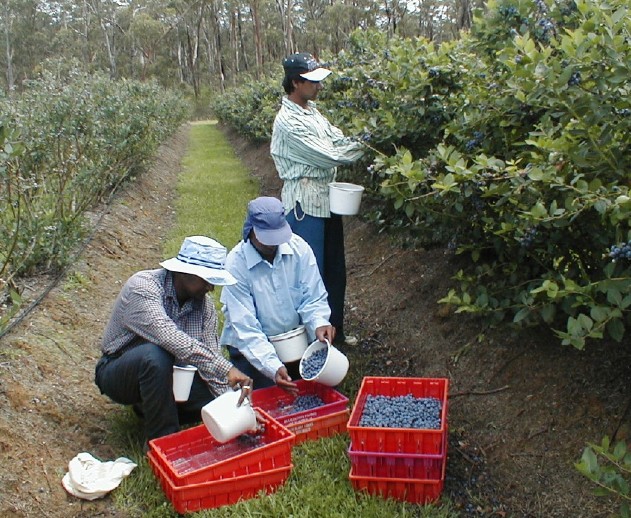
Australia welcomes island fruit pickers
A trial seasonal workers scheme will aid farmers short on produce pickers in New South Wales
RELATED ARTICLES
Atrial Federal Government seasonal workers scheme begins today in Australia, with 50 Tongans flying into the Riverina and Robinvale areas of New South Wales to aid farmers with fruit picking.
The workers will remain in the region for seven months, and will be joined by pickers from Vanuatu, Kiribati and Papua New Guinea when labour hire companies have completed all requirements, the Sydney Morning Herald reported.
Following the trial period, which will see farmers pay for half of the workers' air fares, 2,400 seasonal work visas will become available from July.
"The first group will fly to Sydney and they will help with the harvest of almonds at Robinvale," said Sitiveni Finau, Tonga's Deputy Secretary (labour division). "We will have more workers coming later."
If you are not aware of the modern forms of slavery,
particularly the forms of slavery taking place in modern democratic nations like Australia,
And please be aware -
slavery is alive and well and living in Australia
Australia is not immune to the risks of labour trafficking; labour shortages, sector tolerance to illegal work practices and the recruitment of vulnerable workers can result in labour exploitation (David 2010). The horticultural sector in Australia is experiencing some of these risks and Pacific Islanders are a vulnerable migrant group working in this sector.
Australia’s Pacific Seasonal Worker Pilot Scheme (PSWPS) aims to create a safe pathway for unskilled or low-skilled Pacific Islanders to temporarily work in Australia’s horticultural sector. Recent research by the AIC suggests that addressing labour trafficking does not just involve prosecuting the most extreme cases but should also have a focus on preventing and reducing a broader spectrum of practices that create an environment that is tolerant, or even encouraging, of exploitation (David 2010). While the PSWPS is not an anti-trafficking program, it has been designed and piloted to prevent a broad spectrum of poor or illegal labour practices and therefore may assist to prevent labour trafficking in Australia and regionally. This paper provides an analysis of the PSWPS and examines emerging evidence about how the program manages risks of exploitation of overseas temporary workers from the Pacific Islands.
Wednesday, 13 January 2016
Consumer question of the day --- do you do know what FMCG stands for?
Fast-moving consumer goods (FMCG) or consumer packaged goods (CPG) are products that are sold quickly and at relatively low cost. Examples include non-durable goods such as soft drinks, toiletries, over-the-counter drugs, processed foods and many other consumables.[1][2]
In contrast, durable goods or major appliances such as kitchen appliances are generally replaced over a period of several years. The term was coined by Neil H. Borden in The Concept of the Marketing Mix in 1965 (1996, Prentice-Hall, Inc.).
In contrast, durable goods or major appliances such as kitchen appliances are generally replaced over a period of several years. The term was coined by Neil H. Borden in The Concept of the Marketing Mix in 1965 (1996, Prentice-Hall, Inc.).
FMCG have a short shelf life, either as a result of high consumer demand or because the product deteriorates rapidly. Some FMCGs, such as meat, fruits and vegetables, dairy products, and baked goods, are highly perishable. Other goods, such as alcohol, toiletries, pre-packaged foods, soft drinks, and cleaning products, have high turnover rates.
Though the profit margin made on FMCG products is relatively small (more so for retailers than the producers/suppliers), they are generally sold in large quantities; thus, the cumulative profit on such products can be substantial. FMCG is probably the most classic case of low margin and high volume business. (This information is from Wikipedia)

To be a pro-active consumer has always taken quite a bit of thought.
Consumer boycotts have a long history:
1. Boycotts as we know them today began in the nineteenth century and had quite an effect.
2. In modern times, we are concerned about what is being added to or put into the food we purchase. As well, we are concerned about chemicals in our cleaning products and our cosmetics.
3. We are concerned about animal welfare - cruelty, experimental research etc., lack of humane guidelines for industrial animals.
4. Some of us, but not enough, want to purchase Australian products. The time has long since gone (probably late 1960s/early 1970s) when a consumer could purchase in a supermarket a trolley full of products which were produced wholly in Australia by Australian labour employed by Australian-owned companies.
5. Labelling is often far from truthful and/or transparent. Major powerful food and grocery organisations such as the Australian Food & Grocery Council lobby strongly against simpler and easily understood labelling which is honest about point of origin. So one is left to think that in the confusion there is profit! Perhaps even an escape from Australian standards?
6. Consumers in the 21st century have now to be conscious of Fair Trade and trade in goods produced by forced, exploited and/or slave labour --- even when those goods are made in Australia.
Major corporations are not necessarily cleanskins on this issue. Some of these are multi-national corporations who do one thing in Australia and another in countries where they can get away with less stringent watchfulness and where consumers are unable to demand high standards.

Major corporations are not necessarily cleanskins on this issue. Some of these are multi-national corporations who do one thing in Australia and another in countries where they can get away with less stringent watchfulness and where consumers are unable to demand high standards.
This corporation has a significant production presence in Australia, including in Victoria.
There are no consumer visits to the Nestle factory in Tongala.
The person interested in how these well-known commonly used products
and would like to see how they are produced -
well, you won't get past the reception office and the security there.
Considering that generations of Australians have been supporting
the Tongala community, this seems a bit rich.
The person interested in how these well-known commonly used products
and would like to see how they are produced -
well, you won't get past the reception office and the security there.
Considering that generations of Australians have been supporting
the Tongala community, this seems a bit rich.
Faith fighting slavery - right here in Australia
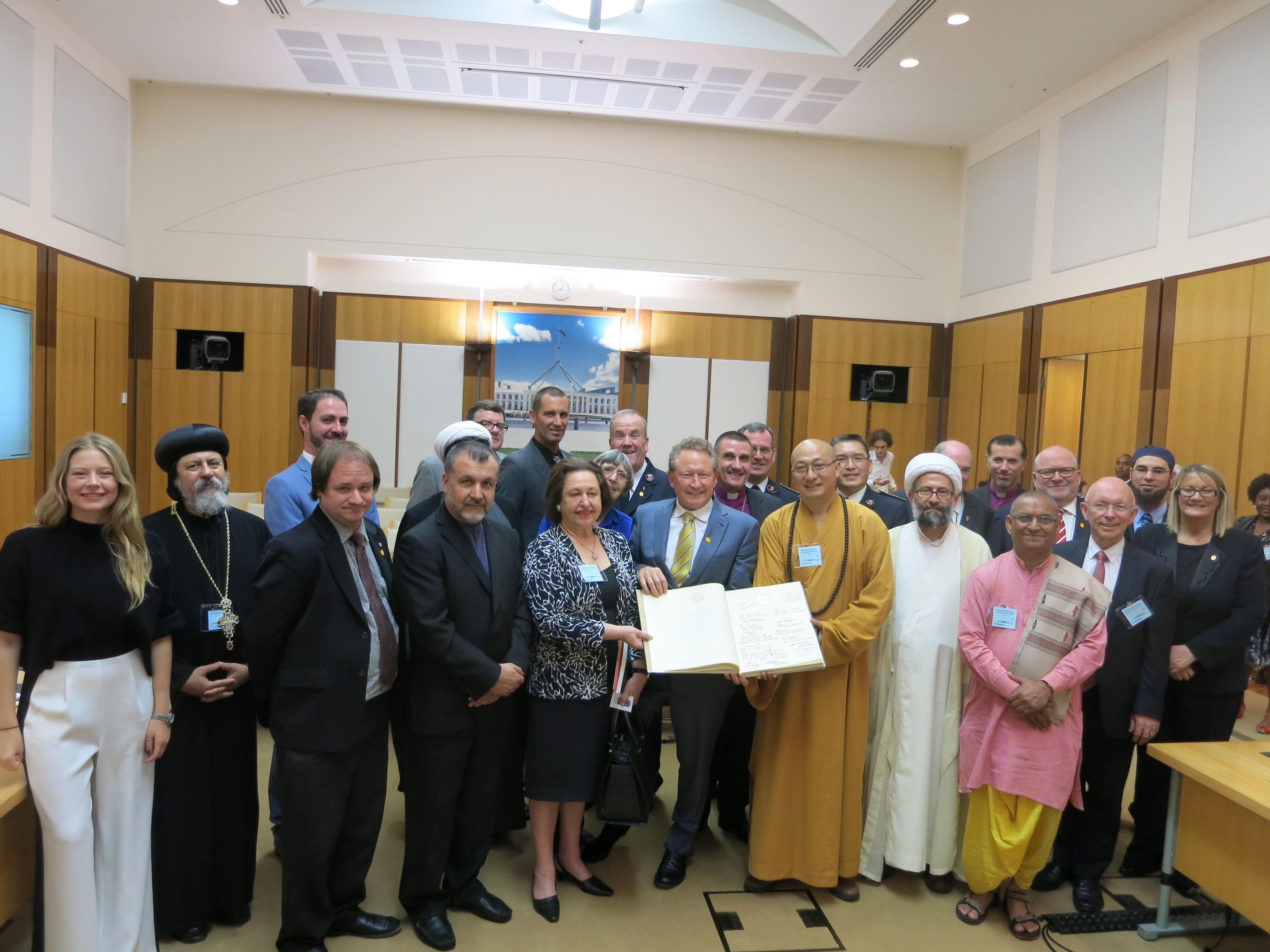
Fighting Slavery with Faith
Despite being outlawed nearly 150 years ago, modern day slavery is a billion dollar industry that affects millions of people in countries around the world – including right here in Australia.
Right now in Australia there are an estimated 3,000 people are currently in slavery or slave-like conditions. This practice is thriving and we, as ordinary everyday Australians, may even be unknowingly supporting it.
Unfortunately, Australia’s decade-long focus on slavery-like conditions in the sex industry has made us blind to the growing and systemic exploitation of people that has firmly taken root in the rest of our economy. International students, backpackers, 457 and other temporary visa holders seeking legitimate opportunities arrive here only to find themselves exploited for profit and forced to work against their will.
For too long we have turned a blind eye to the many different facets of slavery, which has allowed widespread labour exploitation to flourish. The reality is that slaves are cooking our food, cleaning our offices, packing our meat, picking our vegetables, running shops, tiling our bathrooms – and the list goes on.
It’s inconceivable that slavery still exists in 2015, let alone prospers in a developed nation like Australia. That is why it is imperative that government, religious and community groups work together to help eradicate this system that has no place in the modern world.
Today is International Day for the Abolition of Slavery ( 2 December 2015) and senior faith leaders will gather in Canberra at Parliament House to launch the Australian Freedom Network. The Australian Freedom Network will bring together the faith communities of Australia to make a public commitment to develop practical actions to eradicate modern slavery in our nation.
The Salvation Army’s trafficking and slavery safe house continues to support many enslaved people whose stories do not feature in the headlines. Sandra, a Freedom Advocate and survivor, is just one example of someone who was promised a better life in Australia only to be stripped of her autonomy.
Sandra was enslaved as a domestic worker in suburban Sydney for three years without pay after being promised a wage and permanent residency in Australia. Her slaveholders organised her travel to Australia, confiscated her passport and isolated her from the outside world whilst extracting her labour 24 hours a day 7 days per week.
They denied her health care, contact with her family and treated her as an object for their use and abuse.
“I thought I had been abandoned by God,” she has said.
Eventually, Sandra made the brave decision to ask someone for help and take a leap of faith into the unknown consequences of that decision. As a result, she made her way to The Salvation Army and is now an Australian citizen.
Even though Sandra’s slaveholders were not criminally prosecuted, we should still view her story as a success. Ultimately, since finding freedom she has been able to obtain purposeful work and is now an advocate for other survivors. She has shared her story so that we can all benefit from her experiences and insights.
Australian faith leaders have the opportunity create meaningful pathways out of slavery and into a situation of safety, choice and control. But like the wider community, our faith communities lack awareness of the scale and scope to which they may contribute to the enslavement of other people via products and services they use and consume.
Every day individuals purchase goods and services our workplaces and organisations may also use services that may be contributing to the exploitation and slavery of other human beings.
And, so, we are compelled by our faiths to call for transparency and accountability in corporate supply chains. We must do this until we all can be assured that the profits generated by free markets and free trade adequately evidence the production of goods and services by people who are free and being paid a living wage both here and overseas. This includes people whose migration status or visa conditions are being used to abuse their rights.
With the launch of the Australian Freedom Network, Australian faith leaders will send a clear message that slavery in all of its forms is not condoned by religion and we stand collectively against forced labour, human trafficking, debt bondage, servitude, servile and forced marriage.
Amongst our faith communities there is also hope, care and support for people who have experienced slavery to reclaim their freedom. And our message for those who are still enslaved in Australia: “you are not alone.”
James Condon, Commissioner
The Salvation Army Eastern Territory
The Salvation Army Eastern Territory
Tuesday, 12 January 2016
Workplace exploitation of varying degrees in Australia - and how workers are becoming more vulnerable day by day.

Mark Zirnsak is Victorian and Tasmanian social justice spokesman, Uniting Church; Heather Moore is national policy and advocacy co-ordinator, The Freedom Partnership – End Modern Slavery, The Salvation Army.
Mark and Heather have written a most enlightening article for The Age. People not involved in employee organisations might be surprised at how often even otherwise good employers might end up in breach of award wages and conditions - which form part of the industrial laws of Australia. The employers referred to are otherwise good employers who have not set out to defraud or exploit their employees.
Then there are the careless employers. These are the ones who are ill-informed, ill-educated perhaps who don't try to bring their standards up to anywhere near professional. They probably would not know what an award was if it bit them in their painful parts. Their employees are probably offered cash in hand instead of penalty rates and as for a time and wages record - what's that and why bother!
Then there are the third group of employers. The ones who deliberately set out to defraud and exploit working people. The proliferation of labour hire companies in modern Australia has made it very easy for fraudsters and exploiters to multiply to the detriment of human society. In modern Australia, human trafficking continues across a wide number of industries - and in a manner not seen until recently. Go here to find a number of posts relating to the revelations of human trafficking and exploitation in agriculture in Australia made public last year on ABC's Four Corners. 2015 saw the revelations relating to oppression in the 7-Eleven petrol/convenience store chain.
As Adele Ferguson points out in her article:
With 1.3 million workers in Australia on visas, equivalent to one in 10 of the workforce, it has wider economic implications. Besides undermining the award system, it is potentially robbing the Australian Taxation Office of hundreds of millions of dollars a year in tax.
Please note the last sentence because at this point in time the Turnbull Government is indulging in all sorts of cost cutting which will impact widely the most vulnerable Australians.
More could be said of sex slavery in Australia; and of poor Occupational Health & Safety training and conditions which result in severe injuries and even death across many industries; and of the regular exploitation of the 457 system by some employers. 457s are the regulations which allow employers to bring to Australia foreign workers.
Australia has relied strongly over the last century on trade unions and trade union membership to look after the exploited. However, as Australia enters the 21st Century, union membership and participation has declined and the political situation is such that conservative governments try their best to undermine the union movement. A middle-class Labor movement has not helped the situation either.
So if union power and influence declines and governments will not provide appropriate levels of resources for government instrumentalities who have the purview of a variety of workplace practices, then workplace ethics and practices overall will be at best 'iffy' and at worst a form of slavery ... and there will be widespread exploitation in between these extremes.
Read more: http://www.smh.com.au/business/workplace-relations/worker-exploitation-destroys-the-economy-20151001-gjz2sn.html#ixzz3wvRCIfso
Follow us: @smh on Twitter | sydneymorningherald on Facebook
Read more: http://www.theage.com.au/comment/worker-exploitation-head-20160109-gm2fgq.html#ixzz3wvM3koS7
Saturday, 11 July 2015
Help protect children from exploitation.
More than 10% of children over 5 are labourers. Help protect children from exploitation: http://t.co/CEpYyeqo3v pic.twitter.com/sEAdtQmYXG
— World Vision AUS (@WorldVisionAus) July 9, 2015
Sunday, 5 July 2015
Letting migrant workers know what rights they have.
The article below comes from Lapidomedia - Centre for Religious Literacy in World Affairs.
While Australia does not have the huge numbers of migrant workers reported in this article, it does have migrant workers and, on many occasions, they have been exploited. Wouldn't it be good if something similar to this could be provided to them.
 Odeh (right): ‘Unleashing migrants' skills’. Photo: NYUAD
 Revd Andrew Thompson: ‘Honouring’. Photo: Jayson Casper
While Australia does not have the huge numbers of migrant workers reported in this article, it does have migrant workers and, on many occasions, they have been exploited. Wouldn't it be good if something similar to this could be provided to them.
~~~~~
Teaching migrant workers their rights: good news from the Gulf
by - 3rd July 2015
Odeh (right): ‘Unleashing migrants' skills’. Photo: NYUAD
MIGRANT workers long abandoned to slave-like conditions in the Arabian Gulf have found an unlikely weapon in their fight against exploitation: hackers.
Young Arab computer geeks are creatively helping vulnerable foreign labourers break into a culture that either ignores or abuses them.
Last April New York University Abu Dhabi hosted the fourth annualHackathon for Social Good in the Arab World at their campus in the United Arab Emirates (UAE).
More than 150 top university students from seventeen countries competed to design practical apps to innovate solutions for social problems, during a three-day marathon.
An app called Guide Me won the Audience Choice Award, aiming to inform migrants of their rights in law. It also monitors abuse.
26-year-old Mona Demaidi, a mentor from Palestine and a lead programmer for the app is a PhD candidate at the University of Manchester in the UK. ‘Our region needs transparency,’ she told Lapido Media. ‘This project will give data and facts, as we don’t have access to information. And here, it will change lives.’

Mona Demaidi (right): ‘We need the facts’. Photo: NYUAD
With a team of eight students she helped create a system to log calls to a central database from a free helpline to record and track complaints about abuse.
All audio, it will operate in twelve different languages, providing labour law and feedback options for anonymous or on-the-record complaints.
Information is also available on a website, to be accessed from a kiosk at every labour camp.
‘We’re not coming from the West dictating what the problem is and what the solution should be,’ said Sana Odeh, the NYU professor and organizing force. ‘These must come from the students. The power of a hackathon is to unleash students' skills and connect them to the world.’
And though the younger generation is different, there is a significant gap to overcome.
‘We always want to hide our problems, we don’t want to talk about them,’ Demaidi said. ‘But the information collected will be good for the workers, good for the companies, and good for the government.’
According to the Pew Research Center, the Arabian Gulf is home to fifteen million migrant workers, the majority from India, Pakistan, and Bangladesh.
In the UAE they make up 84 per cent of the population, the highest rate in the world. Qatar, Kuwait, and Bahrain follow next on the list.
Revd Andrew Thompson: ‘Honouring’. Photo: Jayson Casper
One link between these workers, the Hackathon, and the government is Anglican priest Revd Andrew Thompson of St Andrew’s Church, Abu Dhabi.
‘The nation has good laws,’ the British vicar who has served in the region for the past 27 years, told Lapido. ‘We just want to assist the government in letting the workers know what they are.'
St Andrew's Church compound is part of the Anglican Diocese of Cyprus and the Gulf. Thompson hosts and oversees an international community of more than ten thousand weekly worshippers, in 45 congregations with 17 language groups.
Thanks to those like Thompson and his teams of volunteers, they now have the law translated into twelve different languages.
Instead of lambasting local negligence, as much of the media do - even Migrants' Rights complain this is counter-productive - Thompson believes in supplementing it.
‘Once you shame an Arab you lose him for life,’ said Thompson. ‘We want to honour all that is right and good, and fill in the gaps where the government isn’t working.’
Tuesday, 19 May 2015
Senate Inquiry into slave and exploited labour in Australia's fresh food chain. Woolworths admits moral responsibility but not legal responsibility.
Cross-posted with The Network
| ||||||||||||||||||||||||||||||||||


Wednesday, 6 May 2015
Picked and packed by exploited labour


The temporary visa program is broken and facilitates the gross exploitation of migrant workers, a view confirmed by the Four Corners program that aired last night.
Urgent action must be taken by the Federal Government to clamp down and regulate the entire temporary visa and labour hire system and remove rogue operators. There should be an immediate halt to any expansion of the temporary work visa program until the full outcome of the Senate Inquiry is known. National Union of Workers http://www.actu.org.au/ |
Subscribe to:
Posts (Atom)