Markets & Justice

Markets & Justice
Freely operating markets yield a just outcome?

White Australia Has A Black History

White Australia Has A Black History
Showing posts with label Horticulture. Show all posts

Saturday, 16 January 2016

Purchases from to-day's Jiggety-jig Market 16-01-16


Back from the Jiggety-jig!
Purchases to-day:
Beetroot. I chose small - easier for pickling in re-used jars.

For some of this quality produce, you will pay a little more.
Sometimes, though, you won't.
If growers get to know you, there's a chance
that they may give a discount.
However, growers have to find numerous uses and varieties'
for the food they have chosen to specialise in.

My regular shopping places are Coles and Aldi.
Each have their uses and their pricing systems.
I rarely enter a Woolworths and when I do,
 don't spend much money there.
The ethics of the major supermarkets are dubious at best.
Woolworths comes out bottom of my list.
For more on Australia's supermarkets,
please purchase a copy of Supermarket Monsters:

So while I may pay a little more
for top of the range value at a growers' market,
this comes from my savings at the supermarkets,
careful budgetting, being a thoughtful consumer,
a vegetarian, and a cook.

My purchases have another purpose.
I am investing, in a small way, in Australian growers.
If we all did this, the investment could become substantial.

Do we want Australian growers to disappear?
Do we want exploited labour so that growers can stay in the game?
Do we want everything to be imported -
and, usually, from places which have subsidised agriculture
such as the United States and the European Union?


Friday, 15 January 2016

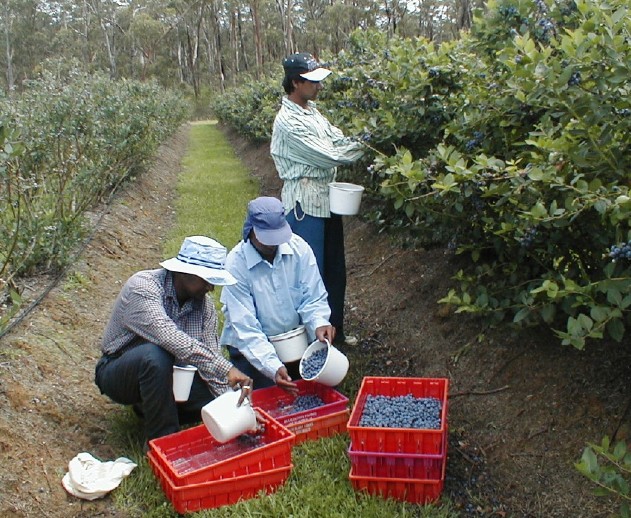
Slavery is alive and well and living in Australia - bringing produce to your dining table. Comfortable with that?


Everything old is new again it would seem.

Blackbirding is the coercion of people through trickery and kidnapping to work as labourers. From the 1860s, blackbirding ships in the Pacific sought workers to mine the guano deposits on the Chincha Islands in Peru.[2] In the 1870s, the blackbirding trade focused on supplying labourers to plantations, particularly the sugar cane plantations of Queensland and Fiji.[3][4] The first documented practice of a major blackbirding industry for sugar cane labourers occurred between 1842 and 1904. Those "blackbirded" were recruited from the indigenous populations of nearby Pacific islands or northern Queensland. In the early days of the pearling industry in Western Australia at Nickol Bay and Broome, local Aborigines were blackbirded from the surrounding areas.
Blackbirding has continued to the present day in developing countries. One example is the kidnapping and coercion at gunpoint of indigenous people in Central America to work as plantation labourers in the region, where they are exposed to heavy pesticide loads and do backbreaking work for very little pay.[5] (from Wikipedia)

~~~~~~~~~

I have known about blackbirding.  I grew up in the North Queensland town of Bowen.  Bowen - as is the case with many coastal towns in Queensland - had/has a significant population of Pacific Island descendants.  My best friend at school was a Vanuatu descendant.  Her cousin is a good friend as well. So when I read headlines such as this below it brings a shiver to my bones.  


Read more: http://www.brisbanetimes.com.au/business/workplace-relations/queensland-labour-company-allegedly-left-fruit-pickers-from-vanuatu-without-pay-20160112-gm4or5.html#ixzz3xFq2Ok4H 
Follow us: @brisbanetimes on Twitter | brisbanetimes on Facebook

....and if you don't know how close to home this is for Victorians>>>

Australia welcomes island fruit pickers

A trial seasonal workers scheme will aid farmers short on produce pickers in New South Wales

Australia welcomes island fruit pickers

RELATED ARTICLES

Atrial Federal Government seasonal workers scheme begins today in Australia, with 50 Tongans flying into the Riverina and Robinvale areas of New South Wales to aid farmers with fruit picking.
The workers will remain in the region for seven months, and will be joined by pickers from Vanuatu, Kiribati and Papua New Guinea when labour hire companies have completed all requirements, the Sydney Morning Herald reported.
Following the trial period, which will see farmers pay for half of the workers' air fares, 2,400 seasonal work visas will become available from July.
"The first group will fly to Sydney and they will help with the harvest of almonds at Robinvale," said Sitiveni Finau, Tonga's Deputy Secretary (labour division). "We will have more workers coming later."


If you are not aware of the modern forms of slavery,
particularly the forms of slavery taking place in modern democratic nations like Australia,

And please be aware -
slavery is alive and well and living in Australia

Australia is not immune to the risks of labour trafficking; labour shortages, sector tolerance to illegal work practices and the recruitment of vulnerable workers can result in labour exploitation (David 2010). The horticultural sector in Australia is experiencing some of these risks and Pacific Islanders are a vulnerable migrant group working in this sector.
Australia’s Pacific Seasonal Worker Pilot Scheme (PSWPS) aims to create a safe pathway for unskilled or low-skilled Pacific Islanders to temporarily work in Australia’s horticultural sector. Recent research by the AIC suggests that addressing labour trafficking does not just involve prosecuting the most extreme cases but should also have a focus on preventing and reducing a broader spectrum of practices that create an environment that is tolerant, or even encouraging, of exploitation (David 2010). While the PSWPS is not an anti-trafficking program, it has been designed and piloted to prevent a broad spectrum of poor or illegal labour practices and therefore may assist to prevent labour trafficking in Australia and regionally. This paper provides an analysis of the PSWPS and examines emerging evidence about how the program manages risks of exploitation of overseas temporary workers from the Pacific Islands.

Saturday, 17 October 2015

Celebrating Fair Food Week at the Jiggety-Jig Farmers Market in #Ballarat

The Editor trotted off jiggety-jig to market, this morning. 
No, she didn't buy the fat pig of the nursery rhyme. 

Being vegetarian, she steered clear of the meat that was available
and focussed on bread and veges. 

 The Jiggety-Jig farmers market was on this morning. 
 Local producers. 

 It costs a little more to purchase the food available at good farmers' markets 
but it is worthwhile to spend a just a little extra 
to purchase local food of good quality 
which has not travelled far from the farm; 
where you can be absolutely guaranteed that free range eggs 
are actually free range.

It is also wise to remember that
if we don't support our local producers and makers
then, one day in the not too far away,
we will lose them.
If we lose them and make ourselves slaves
to imports and cheap foreign government subsidised food,
with these people will go the skills that
ensure that we can feed ourselves.
So purchasing from the locals
is like making a down-payment on
a sort of food insurance policy.

Below is an album of my purchases. 
Some good eating is contained therein