Markets & Justice

Markets & Justice
Freely operating markets yield a just outcome?

White Australia Has A Black History

White Australia Has A Black History
Showing posts with label Pacific Islands. Show all posts

Friday, 15 January 2016

Slavery is alive and well and living in Australia - bringing produce to your dining table. Comfortable with that?


Everything old is new again it would seem.

Blackbirding is the coercion of people through trickery and kidnapping to work as labourers. From the 1860s, blackbirding ships in the Pacific sought workers to mine the guano deposits on the Chincha Islands in Peru.[2] In the 1870s, the blackbirding trade focused on supplying labourers to plantations, particularly the sugar cane plantations of Queensland and Fiji.[3][4] The first documented practice of a major blackbirding industry for sugar cane labourers occurred between 1842 and 1904. Those "blackbirded" were recruited from the indigenous populations of nearby Pacific islands or northern Queensland. In the early days of the pearling industry in Western Australia at Nickol Bay and Broome, local Aborigines were blackbirded from the surrounding areas.
Blackbirding has continued to the present day in developing countries. One example is the kidnapping and coercion at gunpoint of indigenous people in Central America to work as plantation labourers in the region, where they are exposed to heavy pesticide loads and do backbreaking work for very little pay.[5] (from Wikipedia)

~~~~~~~~~

I have known about blackbirding.  I grew up in the North Queensland town of Bowen.  Bowen - as is the case with many coastal towns in Queensland - had/has a significant population of Pacific Island descendants.  My best friend at school was a Vanuatu descendant.  Her cousin is a good friend as well. So when I read headlines such as this below it brings a shiver to my bones.  


Read more: http://www.brisbanetimes.com.au/business/workplace-relations/queensland-labour-company-allegedly-left-fruit-pickers-from-vanuatu-without-pay-20160112-gm4or5.html#ixzz3xFq2Ok4H 
Follow us: @brisbanetimes on Twitter | brisbanetimes on Facebook

....and if you don't know how close to home this is for Victorians>>>

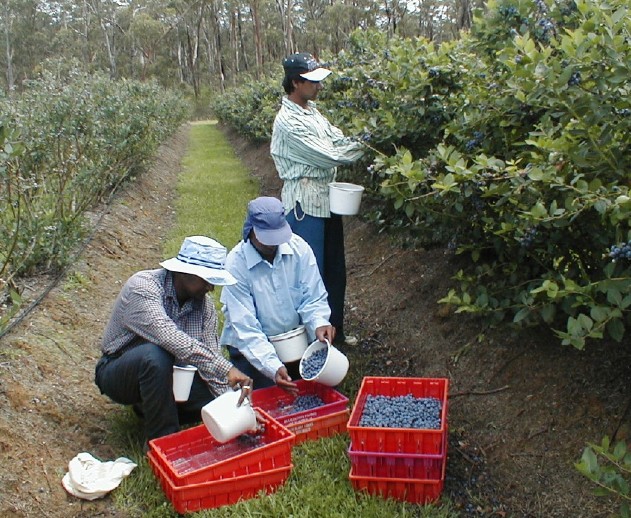
Australia welcomes island fruit pickers

A trial seasonal workers scheme will aid farmers short on produce pickers in New South Wales
Australia welcomes island fruit pickers

RELATED ARTICLES

Atrial Federal Government seasonal workers scheme begins today in Australia, with 50 Tongans flying into the Riverina and Robinvale areas of New South Wales to aid farmers with fruit picking.
The workers will remain in the region for seven months, and will be joined by pickers from Vanuatu, Kiribati and Papua New Guinea when labour hire companies have completed all requirements, the Sydney Morning Herald reported.
Following the trial period, which will see farmers pay for half of the workers' air fares, 2,400 seasonal work visas will become available from July.
"The first group will fly to Sydney and they will help with the harvest of almonds at Robinvale," said Sitiveni Finau, Tonga's Deputy Secretary (labour division). "We will have more workers coming later."


If you are not aware of the modern forms of slavery,
particularly the forms of slavery taking place in modern democratic nations like Australia,

And please be aware -
slavery is alive and well and living in Australia

Australia is not immune to the risks of labour trafficking; labour shortages, sector tolerance to illegal work practices and the recruitment of vulnerable workers can result in labour exploitation (David 2010). The horticultural sector in Australia is experiencing some of these risks and Pacific Islanders are a vulnerable migrant group working in this sector.
Australia’s Pacific Seasonal Worker Pilot Scheme (PSWPS) aims to create a safe pathway for unskilled or low-skilled Pacific Islanders to temporarily work in Australia’s horticultural sector. Recent research by the AIC suggests that addressing labour trafficking does not just involve prosecuting the most extreme cases but should also have a focus on preventing and reducing a broader spectrum of practices that create an environment that is tolerant, or even encouraging, of exploitation (David 2010). While the PSWPS is not an anti-trafficking program, it has been designed and piloted to prevent a broad spectrum of poor or illegal labour practices and therefore may assist to prevent labour trafficking in Australia and regionally. This paper provides an analysis of the PSWPS and examines emerging evidence about how the program manages risks of exploitation of overseas temporary workers from the Pacific Islands.

Saturday, 15 November 2014

The G20 Summit occurring in Brisbane : voices of the Anglican Communion speak out : message from Philip Freier, Primate of the Anglican Church of Australia & Archbishop of Melbourne


Anglican Communion voices speak out ahead of the G20 summit 
Posted on: November 13, 2014 4:17 PM 
The G20 is a forum for the governments and central bank governors 
from 20 major economies 
Photo Credit: G20 

By ACNS staff

Leading figures from the Anglican Communion are speaking out before and during this weekend’s G20 meeting in Brisbane, Australia, on a range of economic and development issues.

The G20 is a forum for the governments and central bank governors from 20 major economies that are said to account for around 85% of the gross world product, 80% of world trade and two-thirds of the world population.

 On the sidelines of the meeting will be people from countries not all represented in the G20, reminding world leaders that global growth should not come at the expense of the world's poorest people.

(l to r) Tagolyn Kabekabe and Abp Winston Halapua 
Photo Credit: ABM
 The Anglican Board of Mission (ABM) reports that the Archbishop of Polynesia, Winston Halapua is asking the G20 to consider how they might co-operate to minimise the impacts of climate change which are already being felt by people in the Pacific Islands.

The Anglican Alliance Regional facilitator for the Pacific will also be in Brisbane during the event. Tagolyn Kabekabe works with communities in the Solomon Islands who are experiencing the erosion of their homelands, poisoning of their food gardens by salt water and increasing exposure to extreme weather events.

Tagolyn represented the Anglican Communion, in particular those in the Pacific directly affected by climate change, at the C20 meeting – a civil society forum that met in June to feed in to the G20 discussions.

The Primate of the Anglican Church of Australia, Dr Philip Freier, has issued a statement in which he warns global leaders that “failure to address these issues of economic security and justice will lead to more international conflict and reduce the possibility of human flourishing”. [His full statement is below]

ABM's Greg Henderson has been organising opportunities for people in Brisbane to meet Archbishop Winston and Tagolyn Kabekabe. He says that it is important for Australians to recognise that climate change is a justice issue, "because its impact is being felt most seriously by communities who have the least power to address the causes of anthropogenic warming".

According to the G20 website, the meeting's agenda has been built around the key themes of
  • promoting stronger economic growth and employment outcomes 
  • making the global economy more resilient to deal with future shocks 
  • strengthening global institutions to ensure they reflect the new realities of the global economy.
For more about the G20’s priorities visit  

Statement by Dr Philip Freier, 
Primate of the Anglican Church of Australia and Archbishop of Melbourne: 

The G20 meeting of the world’s 20 largest economies in Brisbane this weekend takes place in increasingly uncertain times. There are growing fears of global recession, rising international tensions and growing economic inequality between countries and within countries. 

 In the longer term there are vast challenges, such as managing climate change, global population growth and movement, international conflict, food security, water, and potential epidemics. 

It is essential that the countries taking part look beyond their own short-term national interests and seek to address these challenges in a concerted and effective way. I echo Pope Francis, who urged last week that the discussions move beyond declarations of principle to real improvements in the living conditions of poorer families and the reduction of all forms of unacceptable inequality. 

It will require good will and trust on all sides if the G20 summit is to achieve real progress, and it is the nature of international politics that no one wants to go first on such a path. Yet without a clear-sighted optimism, real change will be impossible. 

Failure to address these issues of economic security and justice will lead to more international conflict and reduce the possibility of human flourishing. They cannot be left to fester. The Anglican Church of Australia urges the G20 leaders to search for new and cooperative solutions that can work across the globe. To that end, we offer our support and prayers. 

 +Philip, Primate of the Anglican Church of Australia