
Markets & Justice

Freely operating markets yield a just outcome?
White Australia Has A Black History

Showing posts with label Faith. Show all posts
Showing posts with label Faith. Show all posts
Tuesday, 23 February 2016

Thursday, 11 February 2016
Dale Hess Calendar - Dates for your diaries


Thursday 18 February – Thursday 3 March: Transition Film Festival. The Transitions Film Festival is visionary program dedicated to spotlighting the complex challenges, cutting-edge ideas, creative innovations and mega-trends that are redefining what it means to be human. We present positive, solutions-focused films and showcase cutting-edge ideas from around the world, along with the creative, academic, governmental, community and business leaders who are creating change locally. http://www.transitionsfilmfestival.com/melbourne-program-2016/

Thursday 18 February, 6.30 pm – 8 pm: Market Forces Campaign Launch. Market Forces believes that the banks, superannuation funds and governments that have custody of our money should use it to protect not damage our environment. We're planning to make this year massive. Massive campaigns, resulting in massive change. We have climate change commitments from banks that need to be turned into concrete action that moves finance out of fossil fuels. We want to turn divestment from coal, oil and gas from a steady stream to an unstoppable torrent. And of course, we have new dirty coal proposals here in Australia and overseas that need to be stopped in their tracks. Venue: Treasury Room, Imperial Hotel, 2 Bourke St, Melbourne (corner Spring Street). Food provided, drinks at bar prices. Free entry but bookings are essential as places are limited. RSVP here. Market Forces is proud to be an affiliate project of Friends of the Earth Australia and a member of the BankTrack international network, connecting us with passionate campaigners, environmental issue experts and advocates of environmentally sustainable behaviour from the finance sector.

Saturday 20 February, 5.02 pm – 7 pm: Peace, Faith and Solving Conflict. Invited speakers: Prof. Gary Bouma, UNESCO and Rev.Victor Kazanjian, Global Director United Religions Initiative. Venue: Cultural Infusion Centre, 49 Vere Street, Collingwood College Theatre (entrance from Campbell Street). Sponsored by Cultural Infusion and United Religions Initiative. Free event. Refreshments provided.

Wednesday, 24 February, 7.30 pm – 9.30 pm: Syrian Conflict Information Evening. The Amnesty International Bayside Team are hosting an information evening on the current Syrian crisis. Presenting an impartial account of the current internal armed conflict in Syria, as well as information about the settlement process for refugees and asylum seekers. From 7.30 pm we will have three speakers, discussing the current Syrian crisis, intake of refugees and settlement services for refugees and asylum seekers here in Australia. Tim Redfern from Amnesty International Bayside, Alanna Attard from AMES and Panos Massouris from AMES will be speaking. Venue: The Sandy Beach Centre - 2 Sims Street Sandringham. Register here.

Saturday 5 March, 9 am – 11.30 am: Oases Breakfast Conversation: Listening to Indigenous Voices. Dr Robert Hoskin will share insights from his listening to his Kimberley friends relevant to relating with land and community. Together we will explore how listening means a change of heart, if not our change in approach to life and relationships, and discuss how knowledge of the past might save us from endless repetition in the future. $30/$20 Concession. Main Hall, Habitat Centre for Spirituality, 2 Minona Street, Hawthorn. To book:http://www.oases.edu.au/breakfast/

Monday 11 April; Sunday and Monday, 24 April and 25 April; Sunday 1 May: Ecological Literacy. Ecological literacy was initially used byDavid W. Orr and physicist Fritjof Capra in the 1990s, to understand the Earth as a living system whose well-being was dependent on our thinking in terms of the interdependence of all living systems. In his Web of Life Capra writes of the emergence of a new paradigm challenging the old mechanistic and linear view of the universe and challenging notions of continuous growth and development and with it consumerism and commodification as the “normal”. Ecological literacy is about using this interdependent view of the world to help address the complex dilemmas around the destructive impact that humans have had on the world bringing us to what is often called the Anthropocene… And together we'll draw on the experiences and wisdom of all participants, and the 'natural world' around us. Cost $800. Further details: info@oases.edu.au.

Monday 25 April – Friday 29 April: Living the Peace Testimony with Greg Rolles. Explore the connections between war, militarism, climate change, colonisation of Indigenous peoples, racism – and your own urges to help bring peace. Silver Wattle Quaker Centre, 1063 Lake Road, Bungendore, NSW. Telephone:02 6238 0588

Friday 10 June – Monday 13 June: Indigenous Spirituality and Culture with Karen Kime. Journey into Aboriginal ways of teaching country, kinship and cross-cultural issues in work and community. The workshop will also include examples of other indigenous people. Silver Wattle Quaker Centre, 1063 Lake Road, Bungendore, NSW. Telephone:02 6238 0588

Monday 11 July; Sunday and Monday, 31 July and 1 August; Saturday 10 September: Recreating our Organisations. We live in a world of organisations, educational, familial, work…each with its own culture and processes and each creating its own set of experiences for those who interact with it. Whilst we cannot escape from the reality of organizations in our lives, we can learn to better understand, work with and change (for the better) the organizations in which we play a part…In this unit then our central question addresses the possibilities of recreating or re-imagining the way we organise that would create more soulful, meaningful, value based, collaborative and generative organisations that are relevant for 21st century sustainable and socially just organisations. Cost $800. Further details: info@oases.edu.au.
 |
Monday, 25 January 2016
Exclusion and Embrace 2016: Disability, Justice and Spirituality: broadening our understandings of sacred texts, and the experiences of people with disabilities and carers within the context of faith.
Exclusion and Embrace 2016: Disability, Justice and Spirituality
From August 21, 2016 03:04 until August 23, 2016 05:04

The Australian Catholic University, The Uniting Church Synod of Victoria and Tasmania, The Progressive Christian Network of Victoria Inc., would like to invite you to:
2016 Exclusion and Embrace Conference
Date: 21-23 August 2016
Venue: Jasper Hotel, 489 Elizabeth Street, Melbourne, Australia.
Venue: Jasper Hotel, 489 Elizabeth Street, Melbourne, Australia.
This Conference is a rare opportunity to bring together people interested in understandings of sacred texts, and the experiences of people with disabilities and carers within the context of faith. This multi-faith Australasian Conference has the support of a wide number of organisations including the Jewish Christian Muslim Association (JCMA) and the Faith Communities Council of Victoria (FCCV). The Uniting Church Synod of Victoria and Tasmania is providing the Conference Secretariat.
The Conference will draw on the wisdom of all faiths, and will deepen our understanding of the many aspects of disability and spirituality. We are interested in your experience, research, practice, and ideas and knowledge.
Among the themes explored will be ethics, care, inclusion in faith communities, friendship, discrimination, love, justice, liberation.
In Australia, and abroad, an increasing number of people are actively exploring the intersection of disability and spirituality. An excellent Conference program will present perspectives across the faith spectrum, with opportunities for dialogue and formation of new networks. It will have appeal to people who live with disability, families and carers, academics and practitioners (volunteers and staff).
Two esteemed speakers will be keynoters at our Conference: Prof Hans Reinders is Chair of Ethics at VU University, Holland, and editor of the journal Religion and Disability. Rev Bill Gaventa is Director of the Summer Institute of Theology and Disability and President-elect of the American Association on Intellectual and Developmental Disabilities (AAIDD). We are also delighted that an Australian cast of presenters is increasingly coming on board: Prof David Tacey an interdisciplinary scholar who is widely published for his knowledge of Australian spirituality. Other presenters include Lorna Hallahan, Sheik Isse Musse, Melinda Jones and Diana Cousens (see website Speakers tab for details).
There will also be an exhibition of artworks that reflect people’s experience of disability and spirituality, as it relates to the conference theme.
View and download the brochure (note: when printing remember to tick print on both sides and flip on short edge)
The Conference is also seeking Abstracts within these three streams, as they relate to disability and spirituality.
(i) Supports in faith communities/service providers
(ii) Sacred texts/theological understandings of disability
(iii) Theological Education/Research.
Please go to Call for Presentations for details of Abstract Details and Guidelines. Abstracts need to be submitted by 10 April, 2016. Presentations may include formal papers, posters, personal stories, poetry, or other approaches.
We invite presentations which address aspects and experiences as they relate to spirituality and disability. Themes include liberation, education, bioethics, reconciliation, sexuality, pastoral care, inclusion, love, theological interpretations. All presenters must be registered for the event by 15 July, 2016.
Other sponsors and endorsers include Spiritual Health Victoria, Spiritual Care Australia, Christian Blind Mission, Victorian Council of Churches, Progressive Christian Network Victoria, Australian Catholic University and the University of Divinity.
As part of the Conference, we are also launching and displaying an Art Exhibition, depicting the conference themes. Andy Calder, Conference Convenor
Further Information: Ann Byrne The Uniting Church Synod of Victoria and Tasmania Email: ann.byrne@victas.uca.org.au
Phone: (03) 9251 5404
Endorsed by: Faith Communities Council of Victoria, Jewish Christian Muslim Association of Australia, Victorian Council of Churches, Spiritual Care Australia, Spiritual Health Victoria and University of Divinity.
Saturday, 2 January 2016
Faith in the face of Empire : Palestine : Saul Alinsky
The post below comes from Scarry Thoughts, the blog of Joe Scarry. Joe refers to Alinsky. For those unfamiliar with the life and work of Saul Alinsky and his seminal work in organising communities, please go to:
Saturday, January 17, 2015
How Shall We Live in the Face of Empire? (Reading Mitri Raheb)
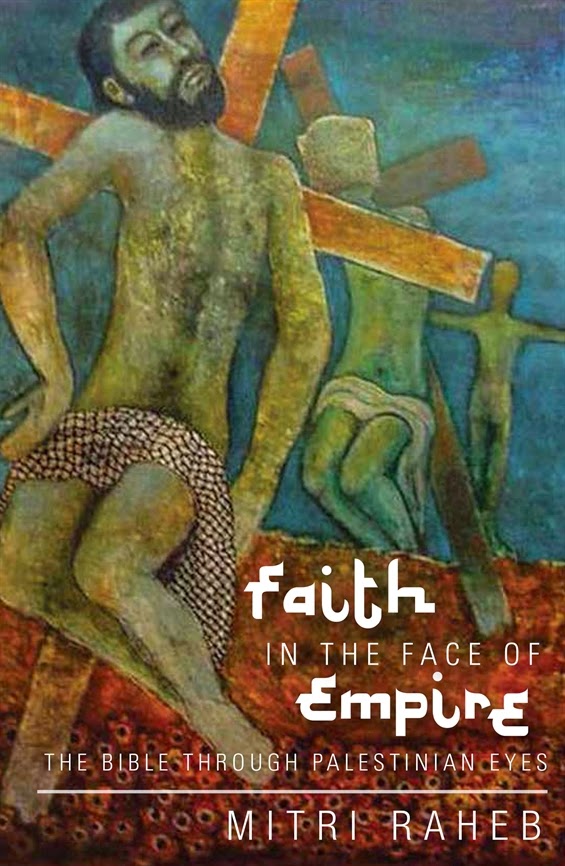
I'm excited to be headed to Israel/Palestine in March, to participate in a study trip lead by Pastor Mitri Raheb of Christmas Lutheran Church in Bethlehem.
I preparation for the trip, I'm reading Pastor Raheb's book, Faith in the Face of Empire: The Bible Through Palestinian Eyes. It's raised some challenging questions for me.
The obvious context is Empire and its power
Pastor Raheb emphasizes that people who are Christians, and people who care about Palestine, and people who fall into both categories, all need to care about the problem of Empire -- because that is the context in which Jesus found himself and because that is the context of Palestine.
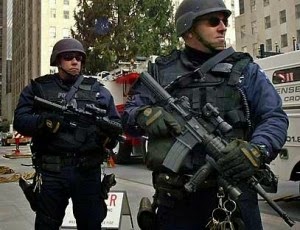 |
"Just another day in [insert city name here]."
|
He emphasizes, moreover, due to geographic factors Empire is and has always been the context in Palestine.
As someone who became a full-time peace and justice activist in the context of Chicago's preparation for the 2012 NATO Summit, I would add that Empire is the context in the U.S., too. (We just do a better job of averting our eyes from it here, in the new Rome.)
That's not a reason to give up on confronting Empire. It's just one of the key facts with which we need to prepare ourselves.
But start where the power isn't
The rather startling thing that Pastor Raheb points out is the way Jesus dealt with that context. We are invited to notice that Jesus did not trek to Rome to take on the power holders. In fact, although he ended up in Jerusalem, the local capital of Empire, that's not where he spent most of his time.
Jesus spent the vast majority of his time in Galilee, and he spent it with a diverse array of ordinary people. Galilee is not a fancy place. It's not where you go if you want to hobnob with the rich and powerful set. The "social network" that you might be able to build in Galilee is . . . well . . . what is it, exactly?
Pastor Raheb challenges us to think about people on the "margins" -- which is simply a way of saying where the power isn't.
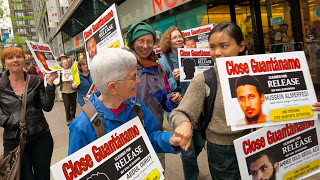 |
Members of the coalition to shut down Guantanamo join hands in Chicago.
|
For somebody like me in who is part of the activist community in Chicago, this is a difficult challenge indeed.
One of Chicago's great traditions is "Alinsky-style" community organizing, that is, community organizing designed to get results, with a no-nonsense focus on power relations and achievable victories, based on the principles of pioneering activist Saul Alinsky.
("Alinsky-style" community organizing is great -- but some of us (for instance, members of the Logan Square Ecumenical Alliance) have been examining whether it is enough. We've been talking about a more "faith-rooted" kind of organizing, one that is less single-mindedly built around "power.")
Another of Chicago's other great traditions is pragmatism. The Chicago apostle of pragmatism, John Dewey, reminded us that we simply can't lose sight of the results we are trying to achieve. In fact, Dewey said, an idea is a function of action and results -- in effect, a "bet" that you place on what is going to work in the real world.
So . . . doesn't everything we do need to serve the struggle? Especially the relationships we build? Isn't it all about power? Isn't it all about results? How can it make sense to keep returning to the margins?
In other words, if the determinant of who you give attention to is not "those with a high likelihood of aiding the struggle," then how can we be confident or hopeful? How can we have faith?
(What's the true context, anyway?)
How is it be possible that we can confront Empire without being forever and always calculating about the potential impact of each and every one of our actions? Is it worth doing anything that isn't aimed at the heart of Empire?
I wonder if that is what Jesus was struggling with as he sought to wrestle control of the words like "kingdom" and phrases like "good news" away from those who had come to believe that the only context in which those words made sense was power and violence.
Certainly fidelity to a Creator God requires that we see that our true context extends much farther and much deeper than the bounds of any Empire (though it is inherent in the conduct of Empire that this truth be denied at every turn).
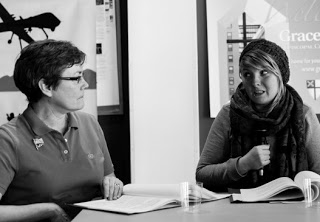 |
Listening and being heard
|
Can we sense that the denseness of the field of human experience and of relationships between people, and the infinitude of possibilities raised thereby, is something we can only begin to plumb, and something that all too easily recedes from consciousness?
I think particularly of Jesus at the well in Samaria. Instead of living out the conventional wisdom, which would lead him to shun anyone he encountered there, Jesus spent the time to listen to the woman at the well. She was taken aback that he could see her, that he could hear her. (In fact, she was so shocked that he was hearing her that she couldn't stop telling others about it.)
I wonder if what Jesus believed was that God's wish for humankind is for us to dwell in this true context, in its entirety.
"Yes, free from the oppression of Empire; but a whole lot more, too."
I wonder if this invites us to undertake a different kind of work. Listening instead of speaking.
I wonder where our "well" is . . . !
SOME QUESTIONS
(1) Is this analysis borne out in scripture? Really?
(2) If this understanding of Jesus is true, what might it lead you to do differently?
(3) Why, in the end, did Jesus go to Jerusalem?
(4) Where does this lead us relative to the conflicts in Israel/Palestine today?
Monday, 16 November 2015
Faith Communities Council of Victoria: statement following events in #Paris and in #Beirut

14th of November, 2015
Statement on acts of violence in Paris and Beirut
The
Faith Communities Council of Victoria has issued the following statement in
response to the recent acts of violence in Paris and Beirut:
As leaders
and people of faith, we offer our prayers and sympathies to family members and
loved ones of those killed and wounded in Paris and Beirut. The loss of
innocent life is senseless and we pray for the victims of these horrible attacks.
We unequivocally condemn these callous and senseless acts of
violence - no belief, cause, or grievance justifies such acts of violence. We
pray that the perpetrators are found and brought to justice.
We must remember
these acts are committed by extremists, who although claim to be Muslims, do
not represent the mainstream Muslim approach to religion or sanctity of life.
Faith
Communities Council of Victoria is comprised of the following peak bodies:
Baha'i Community of Victoria, Brahma Kumaris
Australia, Buddhist Council of Victoria,
Hindu Community Council of Victoria,
Islamic Council of Victoria,
Jewish Community Council of Victoria, Sikh
Interfaith Council of Victoria and Victorian Council of Churches.

Subscribe to:
Posts (Atom)