The material published below is an extract from a post by Steve Hayes on his blog Khanya
The witch hunts of early modern Europe and those in Africa in the late 20th and early 21st centuries have one thing in common: they occurred in societies that were making a transition from premodernity to modernity, and in that sense they are a feature of modernisation.
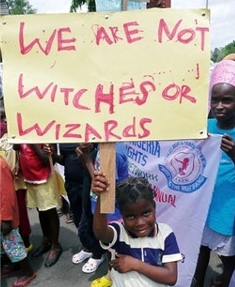
African children protesting against witchcraft accusations
Modernity, however, came earlier to Western Europe, and since the 18th century the witch has no longer been seen as a figure of fear, as can be seen in the popularity of the Harry Potter books. Children in Western Europe often think it is rather fun to dress up as imaginary witches and wizards and pretend to be students at the Hogwarts school of wizardry.
In parts of Africa, however, children have sometimes been accused of being witches, and have been expelled from their families, churches and society in general, and subjected to verbal and physical abuse. In such places, far from playing at being witches and wizards, children often have to deny that they are any such thing.
The so-called modern development in Africa, which some argue should have caused witch beliefs to disappear, has not succeeded in addressing the insecurities people encounter in their daily lives which spun witch beliefs in the first place. Many parts of Africa remain at the margins of completely outside the development equation. Development schemes are absent in rural areas, or they are not accessible or affordable to many people. Modern goods that make it to Africa are limited, outdated, adulterated, and second-hand goods including cars, electronics, drugs, computers, aircrafts, books. So “development” here rides the coattails of modern development.
8 Witchcraft is a big deal.
This is linked to the fact that black people don’t do cats. Witchcraft is real. As real as the fact that when a black woman is pregnant she doesn’t announce it and everyone around her knows not to ask when she’s due. It’s linked to the fear that she will be bewitched if she reveals that kind of information.
So it’s good that missiologists are at last beginning to take this issue seriously. I’m only sorry that it was a missiological journal in North America, and not one in Africa, that is tackling it.


